Mimosa pudica vs. Mimosa tenuiflora: What’s the Difference?
Introduction;
The names Mimosa pudica vs Mimosa tenuiflora can easily cause confusion. Both plants belong to the Mimosa genus, both have finely divided leaves, and both occur in tropical and subtropical environments. However, they are different plant species with different growth habits, characteristics, and ecological roles.
Mimosa pudica is best known as the sensitive plant because its leaves fold in response to touch or mechanical stimulation.
Mimosa tenuiflora, meanwhile, is a woody shrub or small tree known under several common and historical scientific names, including the historical synonym Mimosa hostilis.
So, what is the difference between Mimosa pudica and Mimosa tenuiflora?
This guide compares their botanical characteristics, leaves, flowers, stems, habitats, names, and other important features.
What Is Mimosa pudica?
Mimosa pudica is a plant in the Fabaceae, or legume, family.
It is commonly known as:
- Sensitive plant
- Touch-me-not
- Shameplant
- Sleeping plant
Its most famous characteristic is its rapid response to touch.
When stimulated, its leaflets fold inward and the leaf may droop. The plant can later reopen its leaves once the stimulus has passed.
This unusual movement has made Mimosa pudica a popular plant for botanical education and scientific research.
What Is Mimosa tenuiflora?
Mimosa tenuiflora is a woody member of the Fabaceae family.
It occurs naturally in parts of Mexico, Central America, and South America and is associated with tropical and seasonally dry environments.
You may also encounter the plant under the name Mimosa hostilis.
Mimosa hostilis is a historical synonym associated with Mimosa tenuiflora, which explains why older references and some modern commercial descriptions may use different names.
Mimosa pudica vs. Mimosa tenuiflora at a Glance
| Characteristic | Mimosa pudica | Mimosa tenuiflora |
|---|---|---|
| Common name | Sensitive plant | Jurema preta; also associated with Mimosa hostilis |
| Growth form | Herb/subshrub | Woody shrub or small tree |
| Family | Fabaceae | Fabaceae |
| Genus | Mimosa | Mimosa |
| Leaves | Finely divided compound leaves | Finely divided compound leaves |
| Famous feature | Leaves fold after stimulation | Woody growth and environmental adaptability |
| Stems | Relatively delicate/spreading | Woody branches and trunk |
| Flowers | Small pink-purple flower heads | Small light-colored flower clusters |
| Seed pods | Legume-type pods | Legume-type pods |
| Natural distribution | Tropical America; introduced elsewhere | Mexico, Central America, South America |
| Best-known characteristic | Rapid leaf movement | Woody perennial growth |
Although they share several features, their overall growth form and behavior make them distinguishable.
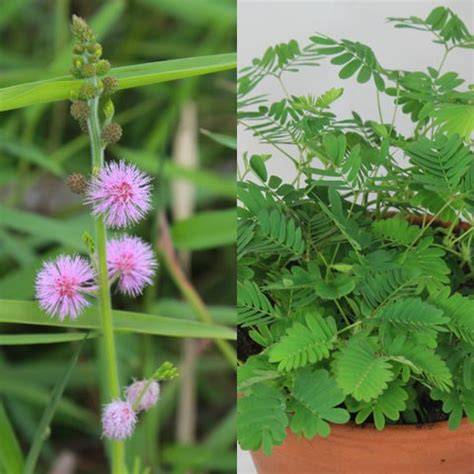
1. Their Growth Forms Are Different
One of the easiest ways to distinguish the two is to look at the entire plant.
Mimosa pudica
Mimosa pudica is generally a low-growing herb or subshrub.
Its stems can spread across the ground or grow upward for a relatively short distance.
Mimosa tenuiflora
Mimosa tenuiflora is a woody shrub or small tree.
It develops persistent woody stems and can become substantially larger than Mimosa pudica.
Simple rule
If you see a small, spreading plant with delicate stems, Mimosa pudica may be a possibility.
If you see a larger woody shrub or small tree, Mimosa tenuiflora becomes a more likely candidate.
However, identification should always involve multiple characteristics rather than plant size alone.
2. Their Leaves Are Similar but Not Identical
Both plants have compound leaves made up of many small leaflets.
This is one of the main reasons beginners can confuse them.
From a distance, the foliage of both species can appear delicate and feathery.
However, closer examination can reveal differences in:
- Leaf arrangement
- Leaflet size
- Leaflet shape
- Number of leaflets
- Overall leaf structure
When identifying either species, photograph the entire leaf rather than just one small leaflet.
3. Mimosa pudica Has a Famous Touch Response
This is probably the most recognizable difference.
Touching Mimosa pudica can cause its leaflets to fold inward and the leaf stalk to droop.
This rapid movement is associated with changes in turgor pressure within specialize structures called pulvini.
The process involves physiological signaling, ion movement, water redistribution, and changes in cellular pressure.
Mimosa tenuiflora is not famous for this dramatic touch-induce leaf movement.
Therefore, the characteristic folding response is a useful clue when distinguishing Mimosa pudica from other Mimosa species.
4. Their Stems Are Different
Stem structure provides another useful identification feature.
Mimosa pudica
The stems of Mimosa pudica are generally more herbaceous or relatively delicate, although mature stems can become somewhat woody.
Mimosa tenuiflora
Mimosa tenuiflora has clearly woody stems and branches.
As the plant matures, its trunk and branches develop a more tree-like structure.
When identifying a mature specimen, examining the stems can therefore be more informative than looking at the leaves alone.
5. Their Flowers Have Similarities
Both species produce small flowers arranged in noticeable clusters.
This shared floral structure is another reason they can look related—which they are.
However, flower characteristics such as:
- Color
- Shape
- Arrangement
- Size
- Position on the plant
can help distinguish them.
When possible, photograph flowering specimens from several angles.
6. Their Seed Pods Can Help With Identification
Both plants produce legume-type seed pods.
Seed pods can be particularly helpful when identifying plants because their shape and arrangement can provide additional morphological information.
When studying a specimen, record:
- Pod shape
- Pod size
- Surface texture
- Number of pods
- How the pod is attach to the plant
Seed pods should be considered together with leaves, flowers, stems, and habitat.
7. Their Habitats Differ
Geographic and environmental information can help narrow down identification.
Mimosa pudica
Mimosa pudica is native to tropical America and has become established in many tropical and subtropical regions outside its original range.
It can occur in disturbed habitats, grasslands, roadsides, gardens, and other suitable environments.
Mimosa tenuiflora
Mimosa tenuiflora occurs naturally across parts of Mexico, Central America, and South America and is strongly associated with tropical and seasonally dry environments.
8. Climate Can Influence Their Appearance
Environmental conditions can change how plants look.
Factors such as:
- Rainfall
- Temperature
- Soil type
- Sunlight
- Water availability
- Seasonal changes
can influence plant height, branching, flowering, and leaf development.
This is why identification should not depend on a single visual feature.
9. Their Scientific Names Are Different
Although both belong to the Mimosa genus, they have different species names:
Mimosa pudica
versus
Mimosa tenuiflora
The second name is sometimes encountered under the historical synonym:
Mimosa hostilis
Understanding scientific names is useful because common names can vary significantly between regions.
For example, “Mimosa” may refer to different species depending on the country and context.
10. Why Is Mimosa tenuiflora Called Mimosa hostilis?
This is a common source of confusion.
Mimosa hostilis is a historical scientific name associated with Mimosa tenuiflora.
Botanical names can change as researchers revise plant classification and taxonomy.
As a result, older books and databases may use Mimosa hostilis, while modern botanical references may use Mimosa tenuiflora.
11. Mimosa pudica Is Known for Plant Movement
The sensitive plant’s movement is scientifically fascinating.
When mechanically stimulated, Mimosa pudica can rapidly change the position of its leaves.
This is different from ordinary plant growth because it happens much more quickly.
The phenomenon provides a useful example of:
- Plant signaling
- Turgor pressure
- Ion transport
- Water movement
- Mechanical sensing
- Plant physiology
12. Mimosa tenuiflora Is a Woody Species
Mimosa tenuiflora is better recognized by its woody growth habit than by rapid leaf movement.
Its ability to grow in seasonally dry environments has made it an interesting species for ecological and botanical research.
Researchers have studied aspects of the plant including:
- Ecology
- Distribution
- Traditional plant knowledge
- Chemistry
- Soil relationships
- Environmental adaptation
13. They Have Different Ecological Characteristics
Plants don’t exist in isolation.
Their characteristics are connected to the environments in which they evolved.
Mimosa pudica can occupy disturbed and open environments, while Mimosa tenuiflora is particularly associated with tropical and seasonally dry landscapes.
Both species can interact with:
- Pollinators
- Herbivores
- Soil organisms
- Other plants
- Local environmental conditions
Understanding their ecology helps explain why they can look different despite belonging to the same genus.
14. How to Tell Them Apart in the Field(Mimosa pudica vs Mimosa tenuiflora)
If you encounter a plant and want to determine whether it might be Mimosa pudica or Mimosa tenuiflora, use a combination of observations.
Step 1 — Look at the size
Is it a small herbaceous plant or a larger woody shrub?
Step 2 — Examine the stems
Are the stems delicate and spreading, or clearly woody?
Step 3 — Examine the leaves
Look at the complete compound-leaf structure.
Step 4 — Observe the response to stimulation
Mimosa pudica is famous for folding its leaves after mechanical stimulation.
Do not repeatedly disturb plants unnecessarily, however.
Step 5 — Look for flowers
Record the color, shape, and arrangement of flower clusters.
Step 6 — Examine seed pods
If present, record their characteristics.
Step 7 — Consider geography
Check whether the plant’s location matches its known distribution.
Step 8 — Compare with authoritative botanical references
Use multiple characteristics before making an identification.
Identification Checklist(Mimosa pudica vs Mimosa tenuiflora)
| Feature | Mimosa pudica | Mimosa tenuiflora |
|---|---|---|
| Low-growing | Common | Less characteristic |
| Woody shrub/tree | No, generally smaller | Yes |
| Compound leaves | Yes | Yes |
| Leaf movement after touch | Characteristic | Not the defining feature |
| Flower clusters | Yes | Yes |
| Legume pods | Yes | Yes |
| Tropical distribution | Yes | Yes |
| Sensitive plant common name | Yes | No |
Why Are These Two Plants Often Confused?
There are several reasons.
1. Same genus
Both belong to Mimosa.
2. Similar foliage
Both have finely divided compound leaves.
3. Similar environments
Both can occur in warm climates.
4. Common-name confusion
Different websites may use different names.
5. Internet images
Photographs can make different species appear more similar than they are.
The best solution is to use multiple botanical characteristics rather than relying on a single image.
Are Mimosa pudica and Mimosa tenuiflora Related?
Yes.
They belong to the same genus, Mimosa, and the same plant family, Fabaceae.
However, being closely related does not mean they are the same species.
Their different species identities reflect differences in morphology, ecology, distribution, and biological characteristics.
Are They Used for the Same Purposes?
Not necessarily.
The two plants have different histories of use and research.
Mimosa pudica is particularly well known as an ornamental and educational plant because of its unusual leaf movement.
Mimosa tenuiflora has a different history involving ecological research, traditional plant knowledge, natural materials, and botanical study.
Specific traditional or commercial uses should always be considered separately from scientific evidence.
Common Misconceptions
“They’re the same plant because both are called Mimosa.”
False.
Mimosa is a genus containing multiple species.
“Mimosa tenuiflora is just a larger Mimosa pudica.”
False.
They are separate species with different growth characteristics.
“All Mimosa plants close their leaves when touched.”
False.
The dramatic touch response is particularly associated with Mimosa pudica and should not be assumed to occur identically across the genus.
“The name Mimosa hostilis means a different species.”
Not necessarily.
Mimosa hostilis is a historical synonym associated with Mimosa tenuiflora.
Conclusion
Although Mimosa pudica and Mimosa tenuiflora belong to the same genus, they are distinct species with important differences.
The easiest distinction is their overall growth habit.
Mimosa pudica is generally a smaller herb or subshrub famous for its rapid leaf-folding response to touch.
Mimosa tenuiflora is a woody shrub or small tree associated with tropical and seasonally dry environments.
Their leaves and flowers share some similarities, which explains why they are sometimes confused. However, examining the whole plant—growth form, leaves, stems, flowers, seed pods, habitat, and geographic location—provides a much stronger basis for identification.
Understanding these differences is useful for anyone interested in plant identification, botany, ecology, or the fascinating diversity of the Mimosa genus.
Important: This article is intended for general botanical education. Photographs and individual characteristics may not be sufficient for definitive species identification. When accurate identification is important, consult a qualified botanist, herbarium, or appropriate botanical authority.