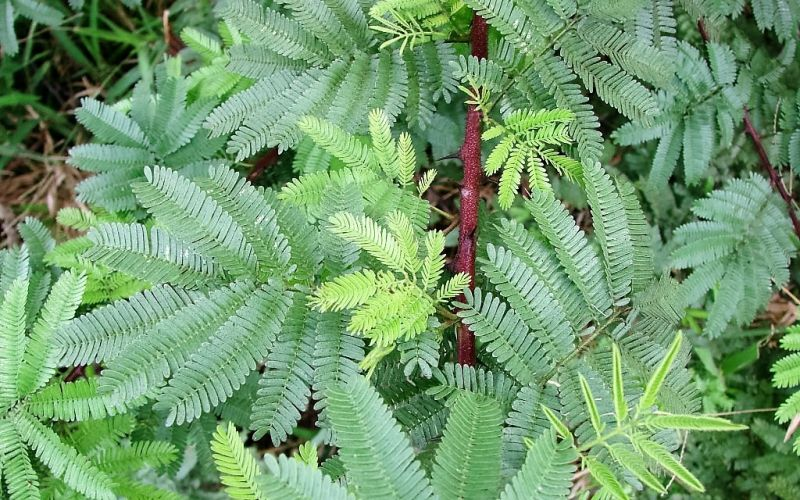
The Mimosa tenuiflora tree is a remarkable tropical plant known for its resilience, distinctive botanical features, and long history of traditional use. Native to parts of the Americas, this species is particularly associated with northeastern Brazil and regions of Mexico and Central America, where it grows in a variety of natural environments.
Scientifically known as Mimosa tenuiflora, the plant is also called Jurema Preta or tepezcohuite in certain regions. It belongs to the legume family, Fabaceae, and may grow as a shrub or a small tree depending on its environment.
From its natural habitat to its bark characteristics and ecological role, the Mimosa tenuiflora tree offers an interesting example of how a single plant species can contribute to local traditions, land use, and botanical research.
What Is the Mimosa Tenuiflora Tree?
The Mimosa tenuiflora tree is a woody flowering plant in the genus Mimosa. It is recognized by its small, compound leaves, slender branches, and clusters of small flowers.
The species is officially accepted under the scientific name Mimosa tenuiflora (Willd.) Poir. by the Royal Botanic Gardens, Kew. The name Mimosa hostilis is also widely encountered in older botanical literature and commercial descriptions, although Kew treats it as a synonym rather than the accepted species name.
The plant is notable for its ability to grow in challenging environments and for its many documented cultural and practical uses.
Basic Botanical Facts
- Scientific name: Mimosa tenuiflora (Willd.) Poir.
- Plant family: Fabaceae
- Plant type: Woody shrub or tree
- Common names: Jurema Preta, tepezcohuite, and Mimosa hostilis
- Native range: Parts of Mexico, Central America, and South America, including northeastern Brazil
- Plant parts of botanical interest: Roots, bark, leaves, flowers, fruits, and seeds
- Growth environment: Tropical and subtropical habitats, including seasonally dry areas
For formal classification and distribution information, consult the Royal Botanic Gardens, Kew plant database.
How to Identify a Mimosa Tenuiflora Tree
Correctly identifying the Mimosa tenuiflora tree involves examining several botanical characteristics rather than relying on a common name alone.
1. Growth habit
The plant can grow as a branching shrub or a small tree. Its overall shape depends on factors such as climate, soil, competition, and disturbance. Mature specimens may develop a woody trunk with spreading branches.
2. Leaves
The leaves are compound and divided into numerous small leaflets. This finely divided foliage gives the plant a delicate appearance and is a useful feature when comparing it with other woody plants.
3. Flowers
The flowers are small and grouped in compact, cylindrical or spike-like clusters. Their pale coloration and clustered arrangement are characteristic features of the species.
4. Bark
The bark is an important identifying feature, although its appearance can vary with the age of the plant and the growing environment. Mature bark may appear brown to dark brown, with surface texture varying between specimens.
The appearance of dried commercial bark may differ from that of bark on a living tree. Color alone is therefore not a reliable way to confirm the species.
5. Fruits and seeds
Like other members of the legume family, Mimosa tenuiflora produces seed-bearing fruits. Examining the fruit, leaves, flowers, and growth habit together can improve identification accuracy.
For reliable identification, compare a specimen with botanical descriptions and authenticated herbarium material. This is especially important when the plant has no flowers or fruits.
Where Does the Mimosa Tenuiflora Tree Grow?
The natural distribution of Mimosa tenuiflora extends across parts of southern Mexico, Central America, and northern South America, including northeastern Brazil. Its presence across different regions demonstrates its ability to tolerate a range of environmental conditions.
The species has been recorded in dry forests, thorny scrublands, wooded areas, and disturbed sites such as roadsides and abandoned agricultural land.
Climate and growing environment
The plant is associated with tropical and subtropical environments. Some populations occur in regions with pronounced dry seasons, where the ability to withstand periods of limited rainfall is ecologically valuable.
Its growth is influenced by several factors:
- Temperature: Warm conditions are generally suitable for active growth.
- Rainfall: Water availability influences seedling establishment and development.
- Soil: Drainage, soil structure, and nutrient availability affect growth.
- Sunlight: Exposure to sunlight influences the development of foliage and branches.
- Disturbance: The plant may establish in open or disturbed habitats where competition from other vegetation is reduced.
Although the species is well known from northeastern Brazil, it is not restricted to that region. Its broader distribution is important when studying its ecology and regional names.
The Ecological Importance of Mimosa Tenuiflora
Mimosa tenuiflora is a legume, a group of plants that includes many species important to natural ecosystems and agriculture.
Legumes are associated with nitrogen-fixing bacteria in root nodules, which can help convert atmospheric nitrogen into forms usable by plants. The extent of this process depends on the species, soil conditions, and compatible microorganisms.
As a woody plant, Mimosa tenuiflora can also contribute to vegetation cover and provide habitat structure in the environments where it grows.
Its presence in disturbed landscapes is of interest to ecologists studying plant regeneration, land management, and vegetation recovery. However, its suitability for restoration projects should be assessed locally rather than assumed for every region.
Traditional Uses of the Mimosa Tenuiflora Tree
Mimosa tenuiflora has a documented history of traditional use in different communities. The plant’s cultural importance varies by region, and its uses should be understood in their historical and local contexts.
Traditional bark applications
In Mexico, bark associated with the plant, commonly called tepezcohuite, has a history of traditional external use for skin injuries and burns. This history has also encouraged scientific interest in the bark’s chemical composition and potential biological properties.
However, traditional use does not automatically establish that every preparation is safe or effective. The concentration, processing, purity, and intended application of a product can all affect its risks.
Cultural significance in Brazil
In northeastern Brazil, Jurema Preta has cultural and religious importance in certain Indigenous and other traditional contexts. Ethnobotanical literature documents the plant’s place in ceremonial traditions.
These traditions should be discussed respectfully and distinguished from commercial descriptions that may omit their cultural context.
Fuel and practical uses
Botanical databases also record practical uses of the species, including fuel and animal-related uses in some contexts. The importance of these uses varies with local conditions and community practices.
Botanical and laboratory research
Researchers have studied the plant’s bark and other parts to investigate its chemical constituents and biological activity. Such studies can help scientists understand the species, but laboratory findings are not equivalent to proven clinical benefits in humans.
For a broader review, see the scientific literature on the traditional uses and biological potential of the genus Mimosa.
What Makes Mimosa Tenuiflora Bark Interesting?
The bark of Mimosa tenuiflora has received considerable attention in ethnobotanical and botanical research. Its structure, chemistry, and documented traditional applications are subjects of scientific investigation.
Researchers have examined the bark’s anatomy and chemical composition, including naturally occurring tannins and alkaloids.
These compounds may vary in concentration according to plant material, location, age, and processing. Different preparations therefore should not be assumed to have identical properties.
It is also important to distinguish the bark of Mimosa tenuiflora from the bark of unrelated plants. Commercial terms and regional names are not always used consistently, so the botanical name is essential when discussing identification or research findings.