Mimosa pudica Explained: Characteristics, Importance, and Fascinating Plant Biology
introduction:
Some plants immediately capture our attention because they behave differently from what we expect. Mimosa pudica is one of them. Commonly known as the sensitive plant, touch-me-not, or shameplant, Mimosa pudica is famous for folding its leaves when touched or disturbed. This unusual movement has made the plant a popular subject for botanical education and plant-science research.
But Mimosa pudica is much more than a plant that “moves.”
Its unusual leaf movement provides an opportunity to understand how plants respond to mechanical stimulation, changes in their environment, and other forms of stress. It also has ecological importance and has become a useful educational example of plant behavior.
In this guide, we’ll explore what this plant is, how it works, why it is important, where it grows, and what makes this plant scientifically fascinating.
What Is Mimosa pudica?
Mimosa pudica is a flowering plant belonging to the Fabaceae, or legume, family.
The species is native to tropical regions of the Americas but has been introduced to and naturalized in various other tropical and subtropical parts of the world.
It is generally a low-growing herb or subshrub with finely divided compound leaves and small pinkish-purple flower heads.
The plant’s best-known characteristic is its ability to rapidly fold its leaves after touch or mechanical stimulation.
Why Is this plant Called the Sensitive Plant?
The name “sensitive plant” comes from its remarkable response to touch.
When a leaf is disturbed, the leaflets can fold inward and the entire leaf may droop.
The response can happen relatively quickly compared with normal plant growth.
This is one reason this plant has become such a familiar example in biology classrooms.
The plant demonstrates that plants can detect and respond to environmental stimuli, even though they do not have a nervous system like animals.
Why Does Mimosa pudica Close Its Leaves?
The movement is known as thigmonasty or, more broadly, a type of nastic movement triggered by mechanical stimulation.
Unlike the directional growth movements seen in some plants, the movement of Mimosa pudica does not depend primarily on the direction from which the stimulus comes.
The response involves changes in water pressure, or turgor, within specialized cells at the base of the leaves and leaflets.
When the plant is stimulated, ion and water movement causes changes in cell pressure. This allows parts of the leaf to change position.
In simple terms:
Touch → cellular signaling → changes in ion and water movement → changes in turgor → leaf movement
This process is one of the most interesting features of Mimosa pudica biology.
What Is Turgor Pressure?
To understand the movement of Mimosa pudica, it helps to understand turgor pressure.
Plant cells contain water and dissolved substances. Water pressure inside cells helps plants maintain their structure.
When cells lose some of their water, their internal pressure can decrease.
In Mimosa pudica, specialized structures called pulvini are involved in controlling leaf movement.
Changes in water balance within these structures can cause the leaves or leaflets to fold or droop.
This demonstrates an important biological principle:
Plants can produce visible movement using changes in cellular water pressure.
What Are Pulvini?
A pulvinus is a specialized swelling found at the base of certain plant leaves or leaflets.
The plural form is pulvini.
In Mimosa pudica, pulvini are important to the plant’s rapid leaf movements.
These structures contain cells capable of changing their turgor pressure.
When the plant receives an appropriate stimulus, physiological changes within the pulvinus cause the leaf to change position.
This makes the pulvinus an excellent example of how plant anatomy can support movement without muscles.
What Happens When You Touch Mimosa pudica?
When a leaf is touched, the plant detects the mechanical disturbance.
Signals are transmitted through the plant, leading to physiological changes in the affected tissues.
Water and ions move within specialized cells, altering their turgor pressure.
The result is the familiar:
leaflet folding → leaf drooping
After a period of time, the plant can gradually return the leaf toward its normal position.
The exact speed of movement and recovery can depend on factors such as temperature, plant condition, intensity of stimulation, and environmental conditions.
Can Mimosa pudica Move Without Being Touched?
Yes.
Mechanical stimulation isn’t the only factor that can influence leaf position.
Environmental conditions such as:
- Light
- Temperature
- Water availability
- Time of day
- Physical disturbance
can influence plant behavior.
Like many plants, Mimosa pudica also exhibits movements associated with daily environmental cycles.
This means the plant’s movement is part of a broader system of physiological responses rather than simply a reaction to someone touching it.
The Difference Between Thigmonasty and Thigmotropism
These two terms are sometimes confused.
Thigmonasty
A movement response trigger by mechanical stimulation where the direction of movement is not determine primarily by the direction of the stimulus.
The rapid folding of Mimosa pudica leaves is a classic example.
Thigmotropism
A directional growth response caused by touch.
Climbing plants that grow around a support provide common examples of touch-related growth responses.
The important distinction is:
Thigmonasty = movement response
Thigmotropism = directional growth response
This makes Mimosa pudica particularly useful when teaching plant movement and plant physiology.
What Does this plant Look Like?
Mimosa pudica is relatively easy to recognize once you know its basic characteristics.
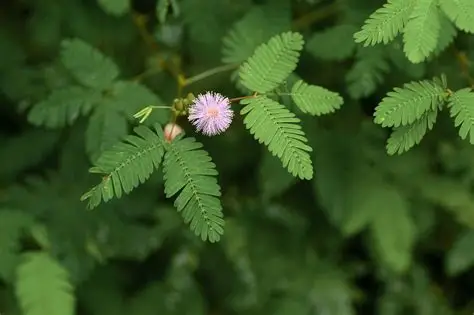
Leaves
The leaves are finely divided and composed of numerous small leaflets.
The foliage often has a delicate, fern-like appearance.
Flowers
The plant produces small rounded flower heads that are commonly pink, lavender, or purple in appearance.
Stems
The stems are generally slender and may bear prickles.
Growth habit
Mimosa pudica is usually low-growing and can spread along the ground or develop into a small subshrub.
Seed pods
Like other legumes, it produces pods containing seeds.
Where Does plant Grow?
Mimosa pudica is native to tropical regions of the Americas but has been introduced into numerous tropical and subtropical regions around the world.
It generally favors warm environments and can occur in disturbed areas, roadsides, grasslands, fields, gardens, and other suitable habitats.
Its ability to grow in disturbed environments has contributed to its spread beyond its original geographic range.
Why Is Mimosa pudica Important?
The importance of Mimosa pudica can be consider from several different perspectives.
1. Importance in Plant Science
Its rapid leaf movements make it a valuable model for studying plant responses to mechanical stimulation.
Researchers can observe changes in:
- Cell physiology
- Ion movement
- Water movement
- Electrical signaling
- Plant behavior
Because the response is visually obvious, it is also useful for demonstrating plant physiology.
2. Importance in Education
Mimosa pudica is an excellent educational plant.
Students can use it to explore concepts such as:
- Plant anatomy
- Plant physiology
- Stimulus and response
- Turgor pressure
- Cellular signaling
- Environmental responses
- Plant behavior
Unlike many biological processes that are invisible without laboratory equipment, the response of Mimosa pudica can be observe directly.
This makes it particularly effective for introducing students to plant biology.
3. Importance in Plant Behavior Research
For a long time, plant behavior was sometimes discuss as though plants simply reacted passively to their environment.
Mimosa pudica provides a striking example of a plant detecting and responding to mechanical stimulation.
Scientists have studied its responses to better understand how plants communicate signals internally.
This contributes to the broader scientific field of plant signaling and plant physiology.
[OUTBOUND LINK: Link “plant signaling research” to a reputable university or peer-reviewed scientific resource.]
4. Importance in Ecological Studies
Plants interact continuously with their surroundings.
Mimosa pudica can interact with:
- Soil
- Water
- Sunlight
- Pollinators
- Herbivores
- Microorganisms
- Competing vegetation
Its ability to grow in disturbed environments also makes it relevant to studies of plant distribution and ecological adaptation.
5. Importance as a Botanical Teaching Example
Mimosa pudica is particularly useful because several biological processes can be demonstrated with one plant.
A single specimen can help illustrate:
Plant structure + environmental response + cellular physiology + movement + adaptation
That makes it one of the more memorable plants used in botanical education.
6. Traditional and Cultural Interest
Mimosa pudica has a long history of traditional use in different regions.
Various cultures have used the plant in traditional practices, and its unusual movement has contributed to its cultural recognition.
However, traditional use should not automatically be interpreted as scientific evidence that a plant is effective or safe for a particular medical purpose.
When discussing traditional uses, it is important to distinguish historical knowledge from clinically established evidence.
[OUTBOUND LINK: Link “traditional uses of Mimosa pudica” to a reputable ethnobotanical or academic source.]
Mimosa pudica vs. Mimosa tenuiflora
Because both plants belong to the Mimosa genus, they are sometimes confused.
However, they are different species.
| Feature | Mimosa pudica | Mimosa tenuiflora |
|---|---|---|
| Common association | Sensitive plant | Jurema preta / Mimosa hostilis |
| Growth form | Herb/subshrub | Woody shrub/small tree |
| Famous characteristic | Leaves fold after stimulation | Woody growth and environmental adaptability |
| Leaves | Finely divided | Finely divided |
| Flowers | Small clustered flower heads | Small clustered flowers |
| Scientific relationship | Same genus | Same genus |
| Species | Different species | Different species |
[INTERNAL LINK: Link “Mimosa pudica vs. Mimosa tenuiflora” to your comparison article.]
Understanding this difference is particularly useful for readers researching plants online because common names and commercial descriptions can sometimes create confusion.
Does Mimosa pudica Have Medicinal Importance?
Mimosa pudica has a history of traditional use and has been investigated in scientific research.
Researchers have examined various aspects of its chemistry and biological activity.
However, laboratory findings and traditional-use reports should not be confused with established clinical evidence.
A scientific study involving a plant extract does not automatically demonstrate that the whole plant is a proven treatment for a human disease.
When discussing the medicinal history of Mimosa pudica, it is therefore important to distinguish between:
Traditional use → laboratory research → animal studies → human clinical evidence
These are different levels of evidence.
Why Do Scientists Continue to Study Mimosa pudica?
Mimosa pudica offers researchers a convenient way to study plant responses because its movements are easy to observe.
Research has explored topics including:
- Plant signaling
- Electrical responses
- Mechanical stimulation
- Turgor regulation
- Ion transport
- Plant memory and habituation
- Environmental responses
Its visible behavior provides a useful starting point for investigating processes that occur at microscopic and cellular levels.
Interesting Facts About Mimosa pudica
Fact 1: It belongs to the legume family
Despite its unusual behavior, Mimosa pudica belongs to Fabaceae, the same broad plant family that includes peas, beans, and many other legumes.
Fact 2: Its movement does not require muscles
The plant uses physiological changes involving specialized cells and water pressure.
Fact 3: Touch is not its only stimulus
Light, temperature, and other environmental conditions can influence its leaf movements.
Fact 4: It is not the same plant as Mimosa tenuiflora
The two belong to the same genus but are separate species.
Fact 5: It has become a model for plant-response research
Its visible movement makes it particularly useful for studying plant physiology.
Why Is Mimosa pudica Interesting to Home Gardeners?
Beyond scientific interest, Mimosa pudica is popular among people who enjoy unusual plants.
Its rapid leaf movement makes it an engaging educational plant for observing plant behavior.
Gardeners interested in growing it should consider factors such as:
- Warm temperatures
- Adequate light
- Suitable soil
- Appropriate watering
- Sufficient growing space
Because growing conditions vary by climate, local horticultural guidance is useful.
Is this plant an Invasive Plant?
The answer depends on location.
A plant can be native in one region and introduced or potentially invasive in another.
Mimosa pudica has been introduced to various parts of the world, and its ecological status differs by region.
Therefore, anyone planning to grow it outdoors should check local invasive-species or environmental guidance.
[OUTBOUND LINK: Link “invasive plant databases” to the relevant government or botanical authority for your target country.]
How does this plant Helps Us Understand Plants
Perhaps the most important lesson from Mimosa pudica is that plants are highly responsive organisms.
They continuously detect changes in:
- Light
- Temperature
- Gravity
- Water availability
- Touch
- Chemical signals
- Environmental stress
They respond through complex physiological processes.
Mimosa pudica makes this invisible world easier to see.
Its leaf movement turns plant physiology into something that can be observed directly.