tepezcohuite cream
Introduction
For centuries, traditional communities in parts of Mexico and Central America have used plants as sources of natural materials for skin care and other purposes. One plant that has attracted particular attention is Mimosa tenuiflora, historically known as Mimosa hostilis. The plant is also associated with the name tepezcohuite, a traditional name particularly connected with its bark. (tepezcohuite cream)
Today, ingredients derived from Mimosa tenuiflora can be found in discussions surrounding natural skincare, botanical cosmetics, and traditional approaches to skin care. One product category that has gained attention is tepezcohuite cream.
But what does science actually say?
Research into Mimosa tenuiflora has investigated compounds and properties associated with antimicrobial, antioxidant, anti-inflammatory, and tissue-repair activity. These findings help explain why the plant has attracted interest in dermatology and cosmetic research. However, laboratory or preliminary evidence should not be confused with proof that a particular cream can treat a medical condition.
This article explores the history, science, and potential skincare relevance of Mimosa tenuiflora while separating traditional knowledge from established medical evidence.
What Is Mimosa tenuiflora?
Mimosa tenuiflora is a woody plant belonging to the Fabaceae, or legume, family.
Many people know the plant by the older scientific name Mimosa hostilis. Major botanical references recognize Mimosa hostilis as a synonym associated with Mimosa tenuiflora.
The plant is naturally distributed across parts of tropical and subtropical America and is particularly associated with regions where seasonal dryness occurs.
Its bark has historically attracted interest because it contains a variety of naturally occurring plant compounds, including tannins and other phenolic constituents.
What Is Tepezcohuite?
Tepezcohuite is a traditional name associated with Mimosa tenuiflora, particularly in Mexico.
The bark has a long history of traditional use, and its reputation in skin care became especially prominent because of its association with traditional wound and skin applications.
This history has contributed to modern interest in tepezcohuite cream, lotions, soaps, and other cosmetic preparations.
However, it is important to understand that a traditional reputation does not automatically establish clinical effectiveness.
Traditional use can provide valuable clues for scientific investigation, but modern clinical claims require appropriate evidence.
Why Is Mimosa tenuiflora Interesting for Skincare?
Interest in Mimosa tenuiflora skincare largely comes from the biological activity of compounds found in the plant.
Research into the Mimosa genus has identified numerous classes of phytochemicals and reported activities including antimicrobial and antioxidant effects.
Researchers have also investigated plant-derived compounds in relation to tissue repair and wound healing.
This has made Mimosa tenuiflora interesting to researchers studying natural ingredients for dermatological and cosmetic applications.
Antimicrobial Properties of Mimosa tenuiflora
One of the most frequently discussed properties of Mimosa tenuiflora is its potential antimicrobial activity.
Certain compounds present in plants can interact with microorganisms in laboratory settings.
Research across the Mimosa genus has reported antimicrobial activity among several plant-derived compounds.
This is scientifically interesting because microorganisms can complicate damaged or compromised skin.
However, there is an important distinction:
Antimicrobial activity observed in laboratory research does not automatically mean that a tepezcohuite cream will prevent or treat a skin infection in humans.
The effectiveness of a finished skincare product depends on factors such as:
- Concentration of active compounds
- Extraction method
- Formulation
- Stability
- Skin penetration
- Manufacturing quality
- Individual skin condition
This is why laboratory findings should be presented as promising research, rather than definitive medical treatment.
Mimosa tenuiflora and Skin Regeneration
The term “regenerative” is often used in discussions about tepezcohuite.
What does it mean?
In skincare research, regeneration generally refers to processes involved in restoring damaged tissue, including:
- Formation of new tissue
- Cellular proliferation
- Re-epithelialization
- Collagen-related processes
- Formation of new blood vessels
- Remodeling of damaged tissue
Research into herbal materials for wound healing has investigated antimicrobial, anti-inflammatory, antioxidant, and tissue-repair mechanisms.
Mimosa tenuiflora has historically attracted attention in this context because of its traditional association with wound care and the biological activity of constituents found in its bark.
However, more high-quality clinical evidence is needed before strong claims can be made about its effectiveness for human wound healing.
Does Mimosa tenuiflora Increase Collagen?
This is an area where careful wording is especially important.
Collagen is one of the major structural proteins in human skin. It contributes to:
- Skin structure
- Strength
- Elasticity
- Tissue repair
Because collagen formation is an important part of wound healing, researchers are interested in whether plant-derived compounds can influence collagen-related processes.
However, saying that Mimosa tenuiflora “boosts collagen” in humans would be too strong without appropriate clinical evidence.
A more accurate statement is:
Research into the plant’s potential wound-healing and regenerative properties has contributed to interest in its possible effects on processes involved in skin repair, including collagen-related pathways.
That distinction makes the article more scientifically credible.
Tepezcohuite Cream: Why Is It Used in Skincare?
Tepezcohuite cream is generally marketed as a botanical skincare product containing an ingredient derived from Mimosa tenuiflora.
Depending on the formulation, a cream may contain other ingredients such as:
- Plant oils
- Humectants
- Emollients
- Preservatives
- Botanical extracts
- Fragrance
- Water-based ingredients
Therefore, two products marketed as tepezcohuite cream may not be chemically or cosmetically identical.
When evaluating a product, look beyond the front label and examine the complete ingredient list
.
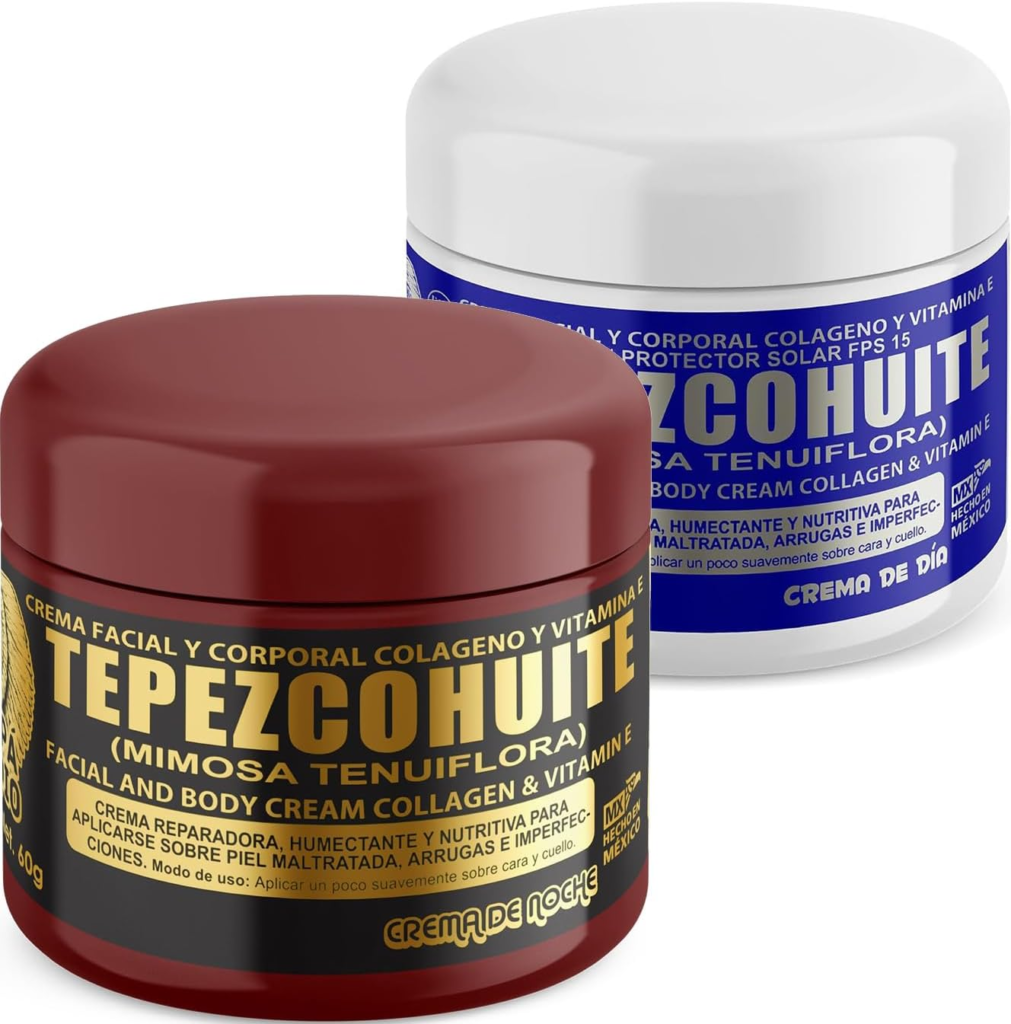
Tepezcohuite Cream and Damaged Skin
The traditional reputation of tepezcohuite is strongly connected with skin repair.
This is one reason it continues to attract interest from people looking for botanical skincare ingredients.
However, damaged skin is not all the same.
There is a major difference between:
- Dry skin
- Minor irritation
- Eczema
- A superficial wound
- A first-degree burn
- A deeper burn
- An infected wound
These conditions require different approaches.
For example, the American Academy of Dermatology recommends cooling a minor first-degree burn with cool tap water and using petroleum jelly and a nonstick sterile bandage; it specifically advises against applying substances such as toothpaste or butter to burns.
Therefore, tepezcohuite cream should not be presented as a substitute for appropriate burn treatment.
Can Tepezcohuite Cream Be Used for Burns?
This is one of the most important questions surrounding the ingredient.
Traditional use and preclinical research have generated interest in Mimosa tenuiflora for wound-related applications. Reviews of herbal approaches to burn healing have examined antimicrobial, anti-inflammatory, antioxidant, and wound-healing mechanisms.
However, that does not mean every tepezcohuite product is clinically proven to treat burns.
For a fresh burn, especially a serious or extensive burn, proper medical care should take priority.
Seek professional medical attention for:
- Deep burns
- Large burns
- Burns involving the face
- Burns involving major joints
- Electrical burns
- Chemical burns
- Burns with extensive blistering
- Signs of infection
A cosmetic cream should never delay appropriate medical treatment.
What About Eczema?
Eczema, particularly atopic dermatitis, is a chronic inflammatory skin condition characterized by symptoms such as dryness, itching, irritation, and inflammation.
The American Academy of Dermatology recommends maintaining the skin barrier with appropriate moisturizers and using evidence-based treatments when needed.
This is important because natural ingredients are not automatically suitable for eczema-prone skin.
Some botanical ingredients can cause irritation or allergic reactions, particularly when they contain fragrance or other sensitizing components.
Therefore, while Mimosa tenuiflora is scientifically interesting for its antimicrobial and potentially regenerative properties, tepezcohuite cream should not be described as a proven cure for eczema.
Could Tepezcohuite Cream Soothe Irritated Skin?
Potentially, depending on the formulation and the individual.
A well-formulated cream can provide an emollient or moisturizing effect simply because of its base ingredients.
For people with eczema-prone skin, dermatologists generally recommend fragrance-free creams or ointments and advise testing new skincare products because ingredients can trigger irritation.
Therefore, if someone chooses to explore a tepezcohuite cream as a cosmetic skincare product, they should examine the complete formulation rather than assuming that the botanical ingredient alone determines how the product will behave on the skin.
Mimosa tenuiflora and Antioxidant Activity
Oxidative stress is another area of interest in botanical skincare research.
Plants contain numerous naturally occurring compounds with antioxidant properties.
Research into Mimosa species has identified several phytochemical groups associated with antioxidant activity.
Antioxidants are interesting in cosmetic science because oxidative processes can contribute to cellular stress and changes associated with skin aging.
Nevertheless, antioxidant activity measured in a laboratory does not automatically translate into a measurable anti-aging effect when applied to human skin.
Traditional Knowledge vs. Modern Science
One of the most interesting aspects of tepezcohuite is the relationship between traditional knowledge and modern research.
Traditional communities have used plants for generations based on accumulated experience.
Scientists can then investigate those plants to determine:
- Which compounds are present?
- How do those compounds behave?
- Are they antimicrobial?
- Do they have antioxidant activity?
- Do they influence inflammatory pathways?
- Are they safe for topical use?
- Does a formulated product actually work in humans?
This process helps transform traditional observations into testable scientific questions.
What Does the Research Actually Tell Us?
The current picture can be summarized like this:
What is scientifically interesting?
Mimosa tenuiflora contains biologically active plant compounds, and research has identified antimicrobial and antioxidant activities among Mimosa species.
What is plausible but requires more evidence?
Its traditional wound-related use and biological activity provide a basis for investigating tissue repair and regenerative processes.
What should not be claimed without stronger evidence?
That Mimosa tenuiflora or tepezcohuite cream definitively:
- Cures eczema
- Heals serious burns
- Prevents scarring
- Rebuilds collagen in humans
- Treats infections
- Replaces prescription dermatological treatment
This distinction is particularly important for responsible skincare marketing.
How to Choose a Tepezcohuite Cream
If you are considering tepezcohuite cream as a cosmetic product, examine the formulation carefully.
1. Check the ingredient list
Look for the botanical ingredient and the other components of the cream.
2. Look for fragrance-free options
Fragrance can trigger irritation in people with sensitive or eczema-prone skin.
3. Check the manufacturer’s information
A reputable manufacturer should provide clear information about:
- Ingredients
- Manufacturing
- Product directions
- Batch information
- Storage
- Contact information
4. Avoid exaggerated claims
Be cautious when a product claims to be a guaranteed cure for multiple skin diseases.
5. Patch-test new skincare products
The American Academy of Dermatology recommends testing new skincare products on a small area before broader use, particularly for people with sensitive skin.
The Importance of Formulation
The plant itself is only one component of a skincare product.
A cream’s performance can depend on its entire formulation.
Factors include:
- pH
- Preservatives
- Concentration of botanical extract
- Extraction method
- Oil-to-water ratio
- Emulsifiers
- Stability
- Packaging
This means that simply adding Mimosa tenuiflora bark powder to a cream does not automatically create an effective skincare product.
Professional cosmetic formulation requires careful control of ingredients and manufacturing conditions.
Mimosa tenuiflora in Modern Natural Skincare
The growing interest in botanical skincare has encouraged researchers to investigate traditional plants using modern scientific methods.
Mimosa tenuiflora fits naturally into this area because it combines:
- A long history of traditional use
- Interesting phytochemistry
- Research into antimicrobial properties
- Interest in antioxidant activity
- Potential relevance to tissue-repair research
- A distinctive botanical history
This makes it an interesting ingredient for cosmetic and scientific research, even though many therapeutic claims still require stronger clinical evidence.