Introduction
Mimosa tenuiflora is a fascinating plant found naturally in parts of tropical and subtropical regions of the Americas. It is particularly associated with dry and semi-arid environments and is known by several regional names.
Many people encounter the plant under the older name Mimosa hostilis. However, Mimosa tenuiflora is the currently accepted botanical name, while Mimosa hostilis is treated as a synonym in major botanical databases.
Learning how to identify Mimosa tenuiflora is important because several plants in the Mimosa genus can look similar at first glance.
This guide examines the plant’s physical characteristics, natural habitat, ecological importance, traditional applications, and areas of scientific research.
What Is Mimosa tenuiflora?
Mimosa tenuiflora (Willd.) Poir. belongs to the Fabaceae, or legume, family.
The plant has historically been known by the scientific name Mimosa hostilis, which is why both names can still appear in books, scientific literature, websites, and commercial descriptions.
The species has a natural distribution extending through parts of Mexico, Central America, and South America, including Brazil.
The plant is particularly interesting because it has adapted to environments where water availability can be limited.
How to Identify Mimosa tenuiflora
Identifying a plant should ideally involve several characteristics rather than relying on one feature.
When examining Mimosa tenuiflora, consider its:
- Leaves
- Stems and branches
- Bark
- Thorns
- Flowers
- Seed pods
- Growth form
- Habitat
The combination of these characteristics provides a more reliable identification than color or appearance alone.
1. Examine the Leaves
The leaves are one of the useful features to examine when identifying Mimosa tenuiflora.
Like other members of the Mimosa genus, its leaves are compound, meaning that a single leaf consists of multiple smaller leaflets.
The foliage gives the plant a characteristic fine-textured appearance.
However, leaf appearance can vary according to:
- Plant age
- Growing conditions
- Season
- Water availability
- Geographic location
For this reason, leaves should be considered together with other botanical features.
2. Look at the Stems and Branches
Mimosa tenuiflora generally develops as a shrub or small tree, although its exact growth form can vary according to environmental conditions.
Its branches can be irregular and spreading.
Young stems and branches may have a different appearance from older woody portions of the plant.
When identifying a plant in the field, examine several branches rather than relying on one young shoot.
3. Examine the Bark
The bark is another characteristic that can help distinguish mature plants.
Older stems develop a darker, rougher outer surface, while younger growth can appear different.
However, bark appearance can vary with:
- Age
- Weather
- Physical damage
- Growing environment
- Moisture
- Part of the plant being examined
Therefore, bark color alone should not be used as definitive proof of identification.
4. Look for Thorns
Mimosa tenuiflora can develop spines or thorns on its branches.
These defensive structures are an important feature to consider when identifying the plant.
However, thorns should not be used as the only identification feature because other plants can also have spines.
A good field identification combines thorn structure with the leaves, flowers, bark, growth form, and habitat.
5. Observe the Flowers
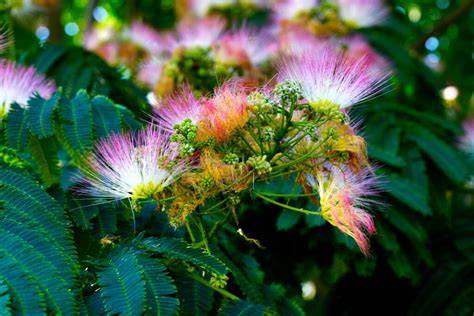
Mimosa tenuiflora produces small flowers arranged in distinctive clusters.
The flowers are typically light-colored and have a fine, rounded appearance caused by numerous stamens.
Flowering characteristics can be particularly helpful when identifying plants because reproductive structures are often more useful for botanical identification than general appearance.
If you encounter a flowering specimen, photograph the flowers along with the leaves and branches for later comparison with a reputable botanical reference.
6. Examine the Seed Pods
Like other members of the legume family, Mimosa tenuiflora produces pods containing seeds.
The appearance of the pods can provide another identification feature.
When available, examining:
Leaves + flowers + pods + branches
can provide much stronger evidence than looking at foliage alone.
7. Consider the Habitat
Habitat can provide an important clue.
Mimosa tenuiflora is particularly associated with tropical and subtropical regions and can occur in relatively dry environments.
It is known for tolerating challenging environmental conditions, including periods of limited water availability.
The location where a plant is growing can therefore provide useful supporting information when combined with physical characteristics.
8. Don’t Confuse Mimosa tenuiflora With Mimosa pudica
One of the most common sources of confusion is Mimosa pudica, often called the sensitive plant or touch-me-not.
Although both plants belong to the Mimosa genus, they are different species.
Mimosa pudica is famous for folding its leaves when touched, while Mimosa tenuiflora is a woody shrub or small tree with different overall characteristics.
This is an important distinction when researching either plant.
Key Identification Features at a Glance
| Feature | Mimosa tenuiflora |
|---|---|
| Family | Fabaceae |
| Growth form | Shrub or small tree |
| Leaves | Compound |
| Branches | Woody, often spreading |
| Defensive structures | Spines/thorns may occur |
| Flowers | Small clustered flowers |
| Fruit | Seed pods |
| Habitat | Tropical/subtropical regions, including dry environments |
| Historical scientific name | Mimosa hostilis |
Remember that individual characteristics can vary, so this table should be used as a starting point rather than a substitute for professional botanical identification.
Why Is this plant Important?
Mimosa tenuiflora is interesting not only because of its physical characteristics but also because of its relationship with the environment and human communities.
Its importance can be considered from several perspectives:
- Ecology
- Soil and land management
- Traditional plant knowledge
- Natural materials
- Scientific research
1. Ecological Importance
Plants adapted to dry environments can play important roles in local ecosystems.
Mimosa tenuiflora is capable of growing in environments where water availability can fluctuate significantly.
Its presence contributes to plant diversity and provides habitat and resources for organisms within its ecosystem.
As with other native plants, its ecological significance depends on the particular environment in which it grows.
2. Relationship With Soil
Members of the legume family have attracted significant scientific interest because many legumes can form relationships with microorganisms associated with nitrogen cycling.
Mimosa tenuiflora has specifically been studied in relation to soil microorganisms and ecological processes.
This makes the species interesting to researchers studying:
- Soil fertility
- Plant–microbe interactions
- Dryland vegetation
- Ecological restoration
3. Traditional Uses
Mimosa tenuiflora has a long history of traditional use in some regions where the plant naturally occurs.
Different parts of the plant have been used historically for purposes including:
- Traditional preparations
- Plant-based materials
- Natural coloring
- Tanning-related applications
- Local craft practices
Traditional use should not automatically be interpreted as proof of medical effectiveness or safety.
When discussing traditional applications, it is useful to distinguish between documented historical use and modern scientific evidence.
4. Mimosa tenuiflora as a Source of Natural Tannins
The bark of Mimosa tenuiflora has attracted scientific attention because of its tannin content.
Tannins are naturally occurring polyphenolic compounds found in many plants.
They have historically been important in applications involving:
- Leather
- Natural dyes
- Plant-based materials
- Textile research
Scientific studies have examined the chemical composition of Mimosa tenuiflora bark and identified tannins among its important constituent groups.
5. Use as a Natural Dye
Mimosa tenuiflora has also been investigated as a source of natural colorants.
Researchers have studied extracts of the plant in textile applications, including experiments involving cotton fabrics.
The resulting color can depend on factors such as:
- Plant material
- Extraction conditions
- Textile fiber
- Mordant
- pH
- Processing conditions
This makes the species an interesting subject for research into plant-based dyes.
6. Interest in Sustainable Natural Materials
Growing interest in plant-based materials has increased attention toward species that have traditionally been used for natural products.
However, “natural” does not automatically mean “sustainable.”
Responsible sourcing requires consideration of:
- Harvesting practices
- Local ecosystems
- Plant populations
- Land management
- Legal requirements
- Community interests
7. Scientific Research
Mimosa tenuiflora has been investigated in several scientific fields.
Researchers have studied aspects of the plant including:
- Botanical identification
- Chemical composition
- Traditional uses
- Ecology
- Plant–microbe relationships
- Natural materials
- Textile applications
The scientific literature is useful because it allows readers to distinguish documented findings from unsupported claims commonly repeated online.
What Makes Mimosa tenuiflora Different From Mimosa pudica?
The two plants are sometimes confused because both belong to the Mimosa genus.
However, they have significant differences.
| Characteristic | Mimosa tenuiflora | Mimosa pudica |
|---|---|---|
| General growth | Woody shrub/small tree | Smaller herbaceous plant |
| Famous characteristic | Dry-environment adaptation | Leaves fold when touched |
| Stem | Woody | Generally softer |
| Habitat | Tropical/subtropical areas, including dry regions | Tropical/subtropical areas |
| Common name | Jurema preta and others | Sensitive plant / touch-me-not |
How to Avoid Misidentification
If you are attempting to identify Mimosa tenuiflora, avoid relying on:
- One photograph
- Bark color alone
- Leaf shape alone
- Common names alone
- Geographic assumptions alone
Instead, compare several characteristics against a reputable botanical reference.
For serious botanical identification, consult a qualified botanist, herbarium, field guide, or recognized botanical database.
Common Misconceptions About Mimosa tenuiflora
Myth 1: A particular bark color proves authenticity
Not necessarily.
Natural bark can vary considerably depending on age, environment, drying, and storage.
Myth 2: Mimosa hostilis and Mimosa tenuiflora are always different plants
Not in botanical nomenclature.
Mimosa hostilis is a synonym associated with Mimosa tenuiflora in major botanical databases.
Myth 3: Mimosa tenuiflora and Mimosa pudica are the same plant
No.
They are separate species within the same genus.
Myth 4: Traditional use proves medical effectiveness
No.
Historical use can be scientifically interesting, but it is not equivalent to clinical evidence.